

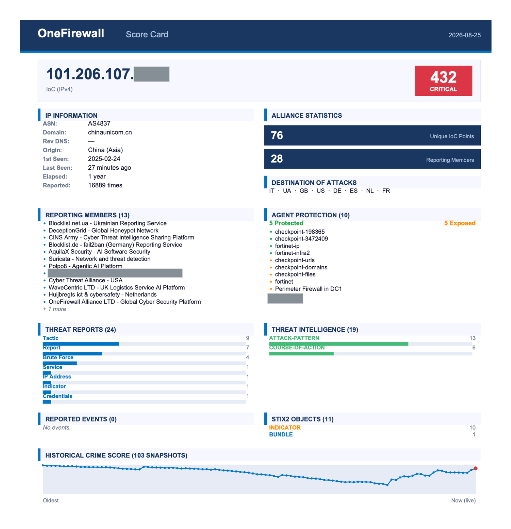
Zero local events, still Critical
The “Reported Events” panel on this card shows zero — this organization has never logged traffic from this address itself. The Critical classification comes entirely from the other 27 members who have. That’s the practical effect of cross-member correlation: an indicator can arrive at a perimeter pre-scored as dangerous, before it ever shows up in that organization’s own logs.Protection isn’t uniform across the fleet
Ten enforcement agents are tracked against this indicator. Five show as Protected — a mix of Checkpoint deployments and a Fortinet device. Five show as Exposed, including a perimeter firewall in one data center. Same organization, same threat data, same score — but the block isn’t applied everywhere yet. That gap is exactly what a policy sync across the fleet is meant to close.A year of activity, no decay
The historical chart behind this score covers 103 snapshots over roughly a year, trending upward rather than flattening out. Crime Scores decay when an indicator goes quiet; this one hasn’t, because it keeps generating fresh reports — the most recent one 27 minutes before this lookup. A year-old indicator that’s still active scores differently than one that spiked once and disappeared.Proof of Value engagements surface indicators like this one already present in a client’s own traffic. Start a Proof of Value.